Celebrating Women as Fun Loving
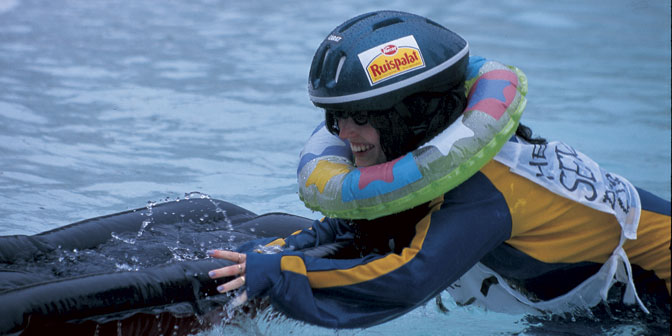
Eukonkannon, Wife Carrying World Championships - Sonkajärvi, Finland
This is an excerpt from the book Celebrating Women
Twenty-two year old Johanna Jauhiainen, who learned to be a trapeze artist in circus school last year, climbs onto Joni Juntunen's back upside down, clamps his head between her thighs and laces her arms around his waist. They are ready to race. “I’m too tall and I’m ten kilos over 49 kilos.” But then, her weight might earn them a bigger prize: winners receive the woman’s weight in beer. “We haven't practiced, and the race starts in two hours,” she laughs. “We are just going to have fun.”
Michael Tohey, a house painter, and Nicole Freese, a bartender, won the North American Wife Carrying Championship at Sunday River Resort in Maine a year ago, and although they set a new American record neither is sanguine now. Michael worries, “This is the cream of the crop of wife carriers. We’ll have to work out some signals so Nikki doesn’t squeeze me too tight. My stomach is already too nervous.” I ask whether the man’s or woman’s role is more important in this sport. Michael defines it as “Collaboration. Definitely. She’s fit and athletic. It takes real strength for her to keep from bouncing, to hold on. You’ll see that. The winner will look like one unit running.” Nicole, who’s a college senior studying Physical Education, admits, “You have to be strong to do well. To hold still against your partner’s body so he doesn’t have to spend time, energy or a moment’s thought worrying about whether you’ll fall off.”
The Estonian women pin their race numbers upside down on their backs, knowing the numerals will read properly when they mount and press their noses to their partners’ spines. They know it takes two-to-ten seconds to cross the water obstacle and
promise themselves they won't slip off in the pond (and incur penalty points). They trust that their partners are tall enough to avoid dunking them, hoping that if they go underwater, they will be able either to wait to breathe or to crane their necks above the surface. It’s actually not much wetter in the pool than out; it’s pouring.
Two by two, the couples tear away from the starting line and enter the pond so fast that sheets of water spray up like transparent wings. They lunge through the pool (a hole in the ground lined with plastic and filled with 55,000 gallons of water), then race through the trees while the crowd screams. Two more obstacles to go: the hurdles (a fairly high wood barrier that stretches across the width of the track and brings every couple to full stop), then a bed of deep sand that defies the need for traction in the final stretch.
David White, a spindly photographer from England’s Daily Mirror, decided at the last minute to carry Jane, his reporter wife. (“We’re probably the only ones where the runner weighs less than the wife.”) He falls exhausted at the finish line, sleeps through the press conference, and awakens just in time to watch the award ceremonies. As the winning runners toss their partners to their shoulders and enter the winners’ circle, David gasps enviously, “How do they do that? I can’t even lift my camera.”