
home button About the Book Button Appearances & Exhibits Button Join the Celebration Button Festival Directory Button Behind the Scenes Button Press Button Contact Us Button
Celebrating Women as Providers
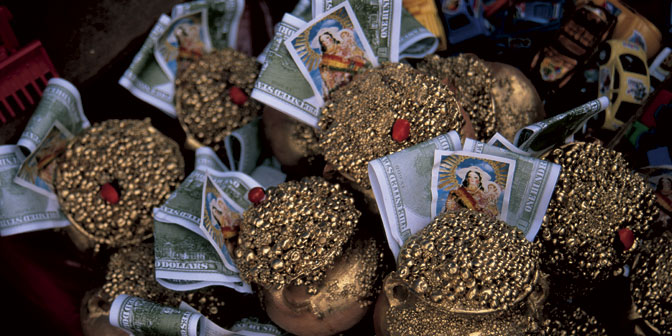
symbols of bolivian money sold at festival
Festival of the Virgin of Candelaria - Puno, Peru
Festival of the Virgin of Urkupiña - Quillacollo, Bolivia
Click here to listen to Paola talk about these festival  


In the region near Puno Peru, inheritance is passed from mothers to daughters.

Husbands join their wives' communities. Women clear the land, conduct business, manage money, own the household belongings and are the more important parents. Like Pacha Mama, women are the providers.

Bolivian Quechuas agree that Pacha Mama provides the basic necessities. They also believe that the Virgin provides material goods. The Festival of Urkupiña was first celebrated in 1670. Today, ten percent of the population of Bolivia (500,000 people) attend the Festival of Urkupiña to ask the Virgin to make their dreams come true. They carry miniatures (alasitas) that represent what they wish for: tiny trucks, television sets, Tudor Houses, telephones, college degrees, cars, clothes, sewing machines, visas and businesses—and more. For two days, they dance to petition and thank the Virgin, then attend a Catholic mass. Finally, they visit the shaman women on the nearby mountain who conduct traditional ceremonies and ask Virgincita/Mamacita to answer the pilgrims' prayers.


This is an excerpt from the book Celebrating Women.

The Quechua tribal people in Peru and Bolivia have integrated their original belief in Pacha Mama (mother earth) with the belief in the Virgin Mary.


buy Celebrating Women link

Quechua people always knew that Pacha Mama gave them the basic necessities required to live: water, food, animal wool for clothing, mud and rocks for houses.

In the seventeenth century, Spanish priests seeking converts told the Andean Indians that Pacha Mama was gone; they should pray to the Virgin Mary. The Quechuas knew Pacha Mama would not abandon them. To them, the Spanish image of the Virgin wearing her triangle-shaped robes looked like a mountain. They decided Pacha Mama and the Virgin must be the same.

At Peru's Festival of Candelaria, 4,000 men, women and children dance in competition for a week to petition and thank Pacha Mama, then for another week to petition and thank the Virgin. They are rewarded with prizes for the best choreography, costumes, masks and music.


    Return Home
copyright © 2004 Paola Gianturco | Site Map